
The climate crisis is one of the biggest challenges facing our planet, and the events industry has an important role to play in being part of the solution.
From the resources we use and the waste we generate to how participants travel and the suppliers we work with, every event has an environmental footprint. With thousands of participants, spectators, volunteers and suppliers coming together at races every year, the collective impact of our industry is significant.
But so is our opportunity to make a difference.
For race organisers, sustainability shouldn't be an afterthought or simply another item on the event checklist. It should be part of the decision-making process from the very beginning – influencing how events are designed, delivered and developed for the future.
So, where do we start?
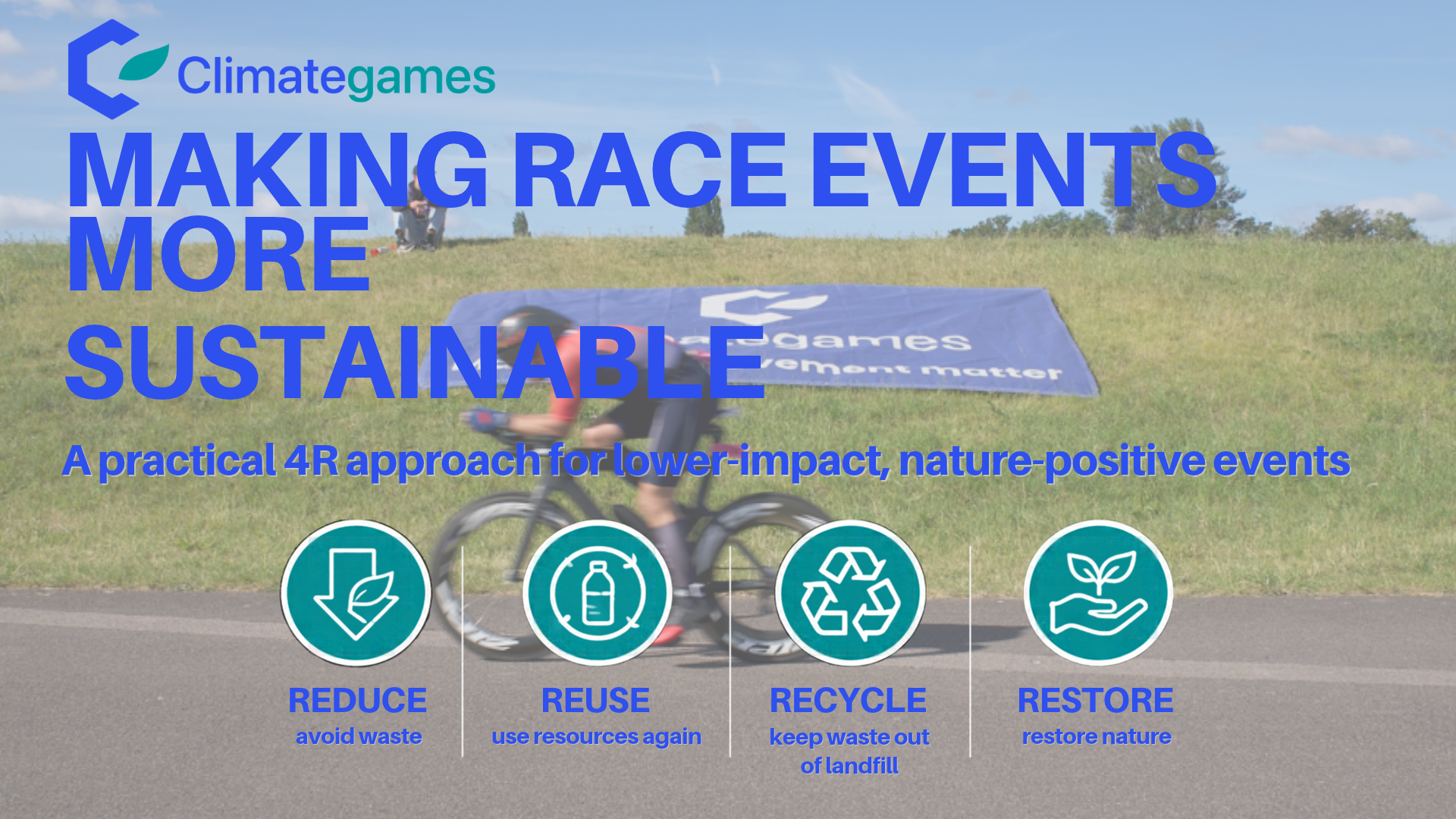
We believe a simple but powerful approach is to follow the 4x RRRR: Reduce, Reuse, Recycle and Restore.
Four practical principles that can help race organisers minimise their environmental impact, make better choices and ultimately create events that give more back to the planet.
1. REDUCE – The most sustainable waste is the waste we never create
The most sustainable thing we can do is avoid creating waste in the first place.
Reducing consumption, unnecessary materials and resource use should always be the starting point when planning a race. Rather than asking how we dispose of something after the event, we should ask whether we need it at all.
Race organisers can make a real difference by:
- Reducing single-use plastics: Rethink disposable cups, bottles, packaging and unnecessary plastic giveaways.
- Going digital: Reduce paper by moving event information, registration, race packs and results online.
- Rethinking catering: Reduce food waste through better forecasting, responsible sourcing and food donation.
- Encouraging sustainable travel: Make it easier for participants to travel by public transport, bike or on foot.
- Reducing energy consumption: Use energy-efficient equipment and consider alternatives to diesel generators.
- Choosing responsible suppliers: Work with partners who share your sustainability ambitions and can demonstrate their environmental commitments.
Small changes across multiple areas can deliver significant results, particularly when repeated across an entire event calendar.
2. REUSE – Events don't need everything to be brand new
The events industry can sometimes operate on a buy-use-dispose mentality. New materials, new signage, new branding and new equipment for every event.
But does everything really need to be new?
By thinking more creatively about what we already have, race organisers can extend the life of event resources, reduce purchasing costs and significantly cut unnecessary waste.
Consider:
- Reusing signage, barriers and event infrastructure across multiple events.
- Encouraging participants to bring reusable water bottles and cups.
- Reusing race equipment, furniture and operational materials year after year.
- Donating or repurposing unwanted clothing, kit and equipment.
- Introducing reusable race-day resources instead of single-use alternatives.
- Designing event branding and signage so it can be used across different locations and editions.
Reuse is about changing our mindset. Instead of seeing materials as disposable, we should see them as valuable resources that can have multiple lives.
It also makes good commercial sense: buying less, wasting less and getting more value from the resources we already own.
3. RECYCLE – Give unavoidable waste another life
Even with the best intentions, some waste will always be generated at sporting events.
When it is unavoidable, we need to make sure as much as possible is recovered, recycled or put to good use rather than ending up in landfill or being incinerated.
However, successful recycling doesn't just happen. It requires planning, infrastructure and the involvement of everyone connected to the event.
Race organisers can improve recycling by:
- Providing clearly labelled recycling points in accessible locations.
- Separating waste streams across event sites, including back-of-house areas.
- Working with waste management partners to ensure materials are correctly processed.
- Engaging suppliers to reduce and recycle their own packaging and materials.
- Educating participants, spectators and volunteers about what can and cannot be recycled.
- Measuring the amount of waste generated, diverted and recycled after every event.
Crucially, organisers need to look beyond simply providing recycling bins. Understanding what happens to the waste after it leaves the event site is just as important.
Measurement matters. If we understand our waste, we can identify opportunities to improve and set meaningful targets for future events.
4. RESTORE – Go beyond reducing your environmental footprint
Reducing, reusing and recycling are essential, but what if events could do more than simply minimise their negative impact?
What if every race could also contribute towards restoring and protecting the natural world?
This is where the fourth R comes in: Restore.
Events have an incredible ability to bring people together around a shared purpose. That collective participation creates an opportunity to support verified environmental and nature restoration projects.
Organisers can support initiatives that:
- Plant trees and restore native woodland.
- Remove plastic pollution from our oceans and waterways.
- Restore coral ecosystems and marine habitats.
- Protect biodiversity and endangered species.
- Restore natural habitats and support ecosystem recovery.
By partnering with credible environmental organisations and projects, race organisers can connect participation with tangible environmental action.
Imagine every ticket sold, every participant taking part or every activity completed contributing towards a verified environmental project.
This creates a powerful connection between participation and positive environmental impact.
It also gives participants another reason to feel proud of being part of an event – knowing that their involvement can help make a difference beyond the finish line.
The ambition should be to move beyond simply being less harmful and towards becoming nature positive, while ensuring that restoration activities complement, rather than replace, meaningful emissions and waste reductions.
From four principles to a more sustainable future
The 4x RRRR isn't about achieving perfection overnight. It's about making better decisions, challenging traditional ways of working and creating a culture where sustainability becomes part of the DNA of every event.
For race organisers, the opportunity is enormous.
By reducing what we consume, reusing what we already have, recycling what we cannot avoid and restoring the natural environment, we can start to reshape the future of our industry.
And importantly, these principles aren't just good for the planet. They can also help organisers reduce costs, improve operational efficiency, strengthen supplier relationships, engage participants and build events that communities are proud to support.
The climate crisis requires collective action. No single race or organisation can solve it alone, but every organiser, every supplier, every participant and every event can play a part.
Let's make every race count – not just for the people crossing the finish line, but for the planet we all share.
Reduce. Reuse. Recycle. Restore.
Four simple principles. One shared responsibility. A better future for events and the environment.
For our full deck check our this link: https://canva.link/shc5wb3n8zi0tut
